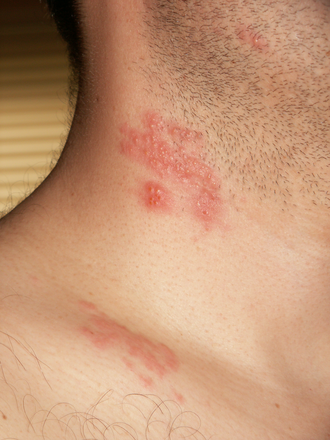
Shingles (herpes zoster) is a painful viral infection that affects around one million people a year in the USA, with comparable rates across Europe — in Denmark roughly 3–4 cases per 1,000 people per year. It is not a new infection: it is a reactivation of a virus you already carry.
In this article we explain what shingles is, how the rash develops, when it is an emergency, and what you can do to shorten the episode and reduce the risk of long-lasting pain.
What is shingles?
Shingles is a viral infection caused by the varicella-zoster virus (VZV) — the same virus that causes chickenpox (varicella). Once you have recovered from chickenpox, the virus does not disappear. It withdraws into the nervous system and lies dormant in sensory nerve cells: in the dorsal root ganglia alongside the spinal cord, and in the cranial nerve ganglia at the base of the skull, including the trigeminal ganglion. It is this cranial reservoir that produces the facial and ophthalmic shingles described below.
When the immune system weakens — through age, illness, stress or medication — the virus can reactivate, travel out along the nerve pathway and reach the skin, where it produces the characteristic rash.
Shingles is not contagious in the same way as chickenpox: you cannot “catch shingles” from someone who has it. If you have never had chickenpox and are not vaccinated, however, you can be infected with VZV from the blisters and go on to develop chickenpox. VZV belongs to the same family of viruses as herpes simplex virus, but they are two different viruses and one does not cause the other.
When is shingles an emergency?
Most cases of shingles can be handled by a GP, but some forms can cost you your sight or your hearing if treatment is delayed. That applies above all when the rash is on the face, or when it spreads beyond a single band.
When to seek urgent help
Contact a doctor the same day — or the out-of-hours service outside surgery hours — if the rash involves the eye, the eyelid, or the tip or side of the nose (Hutchinson's sign). This is herpes zoster ophthalmicus and it can threaten your sight. Also seek help the same day for ear pain with blisters in or around the ear, weakness on one side of the face, hearing loss or vertigo (Ramsay Hunt syndrome, which urgently needs both antivirals and corticosteroids), or if the rash spreads beyond one band to several areas of the body (disseminated zoster). The same applies if you have a fever and feel generally unwell, if the pain is very severe, or if your immune system is suppressed.
What does shingles look like?
Shingles typically progresses in stages and follows a characteristic pattern:
- Prodromal phase (1–5 days): Burning, tingling or tenderness in a defined area of skin — always on one side of the body. Fever, fatigue, headache and light sensitivity can occur before there is anything to see at all.
- Rash phase: A painful red rash appears in a band along the nerve path — most often on the chest, back or waist, but it can also involve the face, eye and mouth. Within a day or two, fluid-filled blisters develop. New blisters usually stop appearing after 3–5 days, and the blisters dry into yellow crusts within 7–10 days.
- Healing phase: The crusts fall off, and the whole episode is generally over 2–4 weeks after the rash first appeared. Marks or scars may be left on the skin, but this is not always the case.
Shingles is strictly one-sided. The rash follows a single dermatome — the strip of skin supplied by one nerve root — and stops abruptly at the midline of the body. A rash that crosses to both sides argues against shingles and points to another diagnosis. This is one of the most useful signs when telling shingles apart from other blistering rashes.
Before the blisters break out, the rash can look like a band of contact dermatitis. The difference usually becomes clear within a day or two, when the clustered blisters appear and the pain is out of proportion to what the rash alone would explain.
Why does shingles happen?
Reactivation of VZV happens when the immune system is no longer strong enough to keep the virus in check. The main triggering factors are:
Why does the risk rise with age?
The immune response that keeps VZV in check weakens naturally with age. The risk of shingles rises markedly after the age of 50, and more than half of all cases occur in people over 60. Around one in three people develops shingles during their lifetime.
A weakened immune system
Conditions such as HIV, autoimmune disease, cancer and organ transplantation — as well as immunosuppressive treatment — increase the risk substantially. These individuals may also have more severe and prolonged episodes and are at greater risk of disseminated zoster.
Stress
Severe physical or psychological stress can temporarily weaken the immune system and thereby increase the risk of VZV reactivation. Many patients can link their episode to a particularly demanding period.
Who gets shingles?
Anyone who has had chickenpox carries VZV and can potentially develop shingles. Certain groups are at particularly high risk:
- Older adults (50+): Risk increases sharply with age. Adults over 80 have 8–10 times the risk of those in their 20s.
- Immunocompromised individuals: Cancer patients undergoing treatment, HIV-positive individuals, and those on long-term steroid or biological therapy.
- Those who had chickenpox very young: Early chickenpox infection, particularly in the first 12 months of life, is associated with an increased risk of shingles in childhood and young adulthood.
How is shingles treated and prevented?
Early treatment matters. The sooner you start antiviral therapy, the shorter and milder the episode:
Antiviral medicines
Aciclovir, valaciclovir or famciclovir should be started within 72 hours of the rash appearing. They shorten the episode and reduce the risk of postherpetic neuralgia. Beyond 72 hours, treatment is still recommended if new blisters are still appearing, if the eye is involved or the rash is disseminated, if the pain is severe, or if your immune system is suppressed.
Pain management
Shingles pain is neuropathic — it comes from the inflamed nerve rather than from damaged tissue — so ordinary painkillers only go so far. Paracetamol is a reasonable starting point, while NSAIDs help little. If that is not enough, the next step is a nerve pain medicine: gabapentin, pregabalin or amitriptyline. A 5% lidocaine plaster applied to healed skin can relieve localised pain. Opioids should not be used before those options have been tried, and are reserved for severe pain under specialist guidance.
Vaccination
The recombinant zoster vaccine (Shingrix) is licensed from the age of 50 and is given as two doses. It prevents around 97% of cases in people aged 50–69 and around 91% in those aged 70 and over. In Denmark it is not part of the publicly funded vaccination programme, so you pay for it yourself — ask your GP or a vaccination clinic about cost and suitability.
Postherpetic neuralgia (PHN)
PHN is the most common complication of shingles: persistent nerve pain lasting months or years after the skin has healed. The risk rises with age. Early antiviral treatment is the most important preventive factor. Contact a doctor if pain continues after the rash has gone — PHN can be treated.
Medical classification: Shingles is classified as 1E91 Zoster in the WHO's International Classification of Diseases (ICD-11). The condition is characterised by a painful rash with a dermatomal distribution, caused by reactivation of the varicella-zoster virus, and is treated with antivirals and pain management.
Frequently asked questions
Can you get shingles more than once?
Yes. Most people only have one episode, but shingles can recur — particularly in people with a weakened immune system. Vaccination lowers the risk of a further episode, including for people who have already had shingles.
Is shingles contagious to others?
Localised shingles spreads only through contact with the fluid from the open blisters, not through the air, and you are no longer infectious once the blisters have dried into crusts. Disseminated zoster, where the rash spreads well beyond one band, can spread through the air like chickenpox. Someone who has never had chickenpox and is not vaccinated can be infected with VZV from the blisters and develop chickenpox — not shingles. Keep the rash covered and avoid contact with pregnant women, newborns and immunocompromised people until it has crusted over.
How long does it take to recover from shingles?
New blisters usually stop appearing after 3–5 days, and the blisters dry into crusts within 7–10 days. The whole episode is generally over 2–4 weeks after the rash first appeared. For some people the pain lasts longer — this is called postherpetic neuralgia.
When should I contact a doctor?
Contact your GP the same day if you think you have shingles — or the out-of-hours service if the surgery is closed. Antiviral treatment works best within 72 hours of the rash appearing. Seek urgent help for a rash around the eye or on the nose, for blisters in or around the ear with facial weakness, for a widespread rash, or for very severe pain.
Contact your doctor the same day
Do not wait for an app assessment if you think you have shingles. Contact your GP — or, out of hours, lægevagten — the same day. Antiviral treatment works best within 72 hours of the rash appearing, and a 48-hour turnaround may be too late.
For other skin changes, and for follow-up after an episode, you can upload photos via the SKIND app and get an assessment from a certified dermatologist within 48 hours.
Disclaimer: This article is for informational purposes only and does not replace professional medical advice. Always consult a doctor or dermatologist for personal guidance and assessment of skin changes.