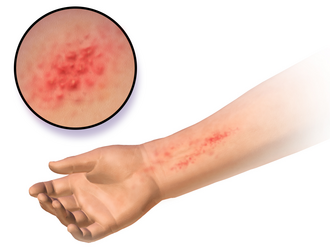
Contact dermatitis — also called contact eczema — is one of the most common skin conditions. It occurs when the skin reacts to a substance it has touched. It can affect anyone — regardless of age or skin type — and presents as redness, itching, blisters or dryness on the affected areas.
In this article, we explain exactly what contact dermatitis is, the two main types that exist, what it looks like, how patch testing works, and what you can do about it.
What is contact dermatitis?
Contact dermatitis — also known as contact eczema — is an inflammatory skin condition that arises as a direct reaction to a substance the skin has touched. Unlike atopic eczema, contact dermatitis always requires an external trigger. Inherited factors still matter, though: if your skin barrier is naturally weaker, less exposure is needed before the skin reacts. It also means that if you can identify and remove the trigger, symptoms often disappear.
There are two main types of contact dermatitis, and it is important to distinguish between them as treatment may vary:
- Irritant contact dermatitis: The most common type. Occurs when a substance directly damages the skin's protective barrier — regardless of whether you have been exposed to it before. Anyone can develop it with sufficient exposure.
- Allergic contact dermatitis: An immune reaction in which the body's immune system reacts to a specific allergen you have previously been sensitised to. Only people with that specific hypersensitivity develop symptoms.
What does contact dermatitis look like?
Symptoms vary depending on the type and severity of the reaction, but common signs include:
- Redness and inflammation: Affected areas may appear red, swollen and warm to the touch.
- Itching and burning: Intense itching, burning or stinging sensations are typical.
- Blisters and bumps: In some cases, small blisters or bumps may develop on the affected skin.
- Dryness and scaling: Chronic exposure can lead to dry, cracked and scaly skin.
Contact dermatitis typically appears on the hands, wrists, arms and face — areas most often in contact with irritant substances. The reaction is often limited to the area that has been in direct contact with the trigger, but in allergic cases it can spread to other areas.
Why does contact dermatitis happen?
The cause depends on the type:
What causes irritant contact dermatitis?
Direct damage to the skin. Irritant contact dermatitis occurs when a substance damages the outermost protective layer of the skin — the epidermis. The damage disrupts the barrier function and triggers inflammation. The stronger the irritant and the longer the exposure, the greater the risk.
Common irritants include soaps, detergents, solvents, oils, acids, alkalis and plants such as nettles. Even repeated water exposure — for example frequent hand washing — can dry out the skin and lead to irritant dermatitis.
What causes allergic contact dermatitis?
A delayed immune reaction (type IV hypersensitivity) in which the immune system is activated against a specific allergen. The reaction may take 24–72 hours to appear after exposure.
Common allergens include nickel (in jewellery and metal parts), fragrances, cosmetics, preservatives, balsam of Peru, certain medications and resins from plants. Even products you have used for years can suddenly trigger an allergic reaction, because sensitisation can develop over time.
Why is latex a different kind of allergy?
Because natural rubber latex is the classic type I allergen. The reaction is IgE-mediated and begins within minutes — not hours. Latex allergy causes contact urticaria (hives) at the site of contact, swelling of mucous membranes (angio-oedema) and, at worst, anaphylaxis. Note that rubber gloves can also cause a classic delayed type IV allergy to the chemicals used to make the rubber — two entirely different reactions to the same product.
When to seek urgent help
Call 112 if, after contact with latex or another allergen, you develop swelling of the face, lips, tongue or throat, wheezing, difficulty breathing, dizziness or sudden widespread hives. This can be anaphylaxis, which develops within minutes and needs adrenaline immediately. If you have been diagnosed with latex allergy, tell every dentist and hospital department that treats you.
Who gets contact dermatitis?
Anyone can develop contact dermatitis, but certain factors increase susceptibility:
- Frequent exposure to chemicals: Healthcare workers, hairdressers, cleaning staff and mechanics are particularly exposed.
- Underlying skin conditions: People with atopic eczema have a weakened skin barrier and are more susceptible.
- Specific allergens: Nickel allergy is among the most common contact allergies worldwide.
- Occupations with high exposure: Hairdressers, laboratory workers, metalworkers, healthcare workers and agricultural workers have elevated risk.
How does patch testing work?
Small amounts of the most common allergens are applied to the back under adhesive patches. The investigation takes several visits over about a week: the patches go on, come off after 48 hours, and the skin is read again at 72–96 hours, because a type IV reaction develops slowly.
Preparation matters a great deal for the result. Topical steroids must not be used on the test site in the weeks beforehand, and systemic steroids or other immunosuppressive treatment should be avoided where possible, since both can suppress a genuine reaction and produce a false negative. The back also needs to be kept dry, and heavy sweating and sun exposure should be avoided during the test period.
What can you do about contact dermatitis?
Contact dermatitis is manageable, and in most cases symptoms disappear once the trigger is identified and removed. The key to success is a combination of avoidance, skincare and medical treatment:
Identify and avoid the trigger
This is the most important step. Keep a diary of symptoms and activities, and discuss patch testing with a dermatologist to identify specific allergens.
Protect the skin
Wear protective gloves when handling chemicals. Moisturise the skin regularly with fragrance-free moisturisers to strengthen the barrier function.
Medical treatment
Corticosteroid creams or ointments are the standard treatment for inflammation and itching. For severe or widespread allergic contact dermatitis, the standard of care is a short, tapering course of oral corticosteroids — typically over 2–3 weeks — since a more potent topical steroid alone is rarely enough.
Gentle skincare
Avoid soaps with fragrance and harsh surfactants. Use lukewarm water instead of hot water, and avoid rubbing the skin dry. Choose cleansers and moisturisers formulated for sensitive skin.
Medical classification: In the WHO's International Classification of Diseases (ICD-11), contact dermatitis is divided into allergic contact dermatitis (EK00) and irritant contact dermatitis (EK02). Irritant contact dermatitis accounts for approximately 80% of all cases. Treatment is based on identification and avoidance of the trigger plus topical steroids.
Frequently asked questions
Is contact dermatitis contagious?
No, contact dermatitis is not contagious and cannot be spread from person to person. It is a local skin reaction to an irritant substance or allergen.
When should I contact a dermatologist?
Contact a dermatologist if the rash is extensive, does not improve after a week of avoidance, worsens significantly, or if you suspect a specific allergen that needs to be identified through patch testing.
How do I prevent contact dermatitis?
Prevention is about minimising contact with known irritants and allergens. Wear protective gloves, choose fragrance-free products, and keep the skin moisturised with gentle creams to strengthen the barrier function.
Get an assessment within 48 hours
If you have a persistent skin rash you cannot identify, you can get a personal assessment from a certified dermatologist via the SKIND app — with no waiting list.
Disclaimer: This article is for informational purposes only and does not replace professional medical advice. Always consult a doctor or dermatologist for personal guidance and assessment of skin changes.