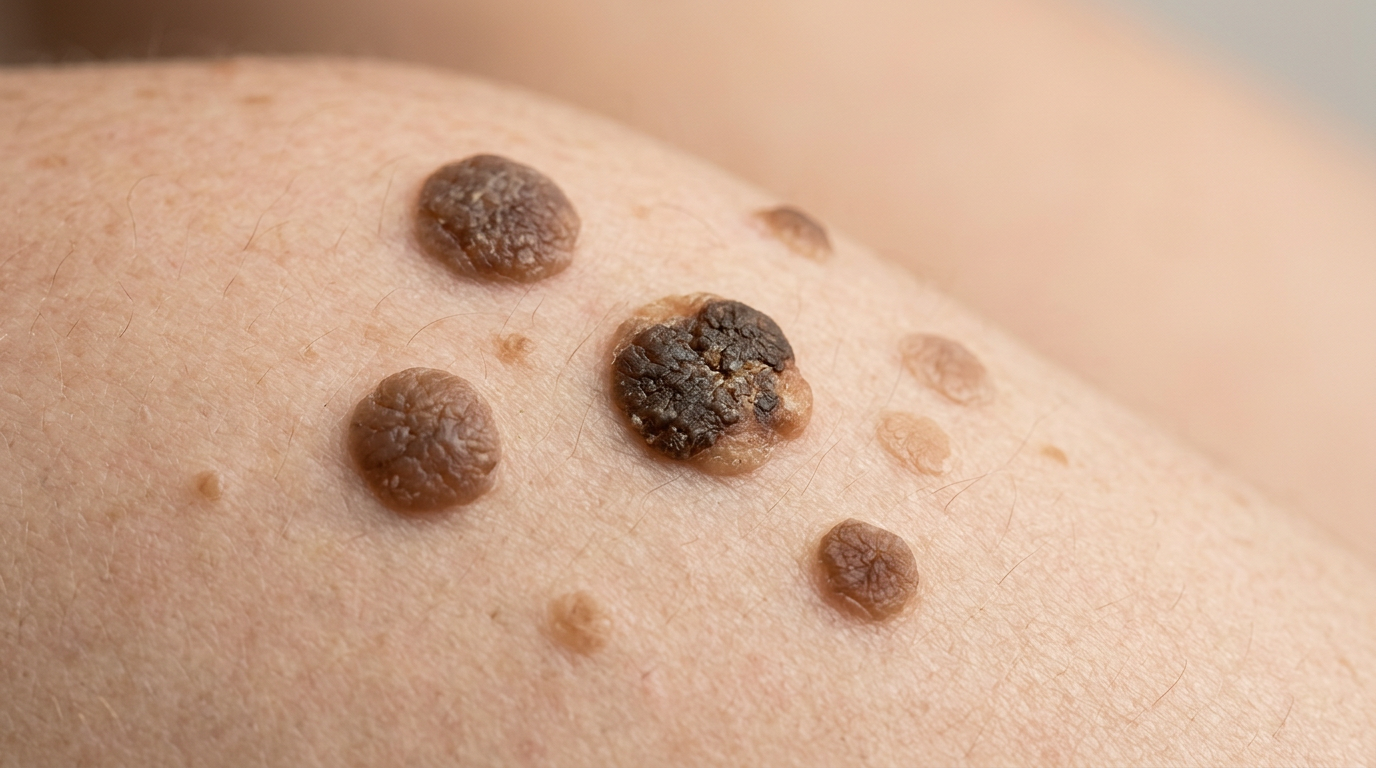
Seborrhoeic keratosis is one of the most common skin growths in adults over 50 — and one of the most misunderstood. Seborrhoeic keratosis itself is benign and does not turn into cancer. However, it can look very similar to melanoma and other skin cancers, so any pigmented growth you are unsure about should be assessed by a dermatologist.
In this article, we explain exactly what seborrhoeic keratosis is, what causes it, how to tell it apart from something more serious, and what you can do about it.
What is seborrhoeic keratosis?
Seborrhoeic keratosis — also called senile warts or age warts — is a benign skin growth that develops in the epidermis (outer layer of skin). These growths are not contagious, and the growth itself does not turn into cancer. Their appearance varies, but they are typically easy to recognise: round or oval, with a clear border from the surrounding skin, as if they have been "stuck on".
They can appear alone or in clusters and grow slowly over time. Most people will develop at least one during their lifetime.
What does seborrhoeic keratosis look like?
Seborrhoeic keratosis can vary considerably in appearance:
- Colour: Brown, black or light tan — the colour can vary within the same growth.
- Texture: Rough, wart-like or waxy surface. They often feel slightly raised.
- Size: From a few millimetres to several centimetres in diameter.
- Location: Most often on the face, neck, chest, back and shoulders — but can appear anywhere on the body except the palms and soles.
The "stuck on" appearance is characteristic and distinguishes seborrhoeic keratosis from, for example, ordinary moles, which sit deeper in the skin. That feature alone is not reliable enough to make the diagnosis.
What causes seborrhoeic keratosis?
The exact cause is still unknown. It is not contagious and is not caused by poor hygiene or diet. Researchers point to several contributing factors:
What role does age play?
Seborrhoeic keratosis is mainly a condition of the second half of life: the first growths often appear from the 30s onwards and become steadily more common after 50. One variant, dermatosis papulosa nigra, appears as small, dark papules on the face and neck and is common from adolescence in people with darker skin.
Is seborrhoeic keratosis hereditary?
There is a clear hereditary tendency. If your parents had many seborrhoeic keratoses, the likelihood of you developing them yourself is significantly higher.
Does sun exposure matter?
Although sun exposure is not the direct cause, seborrhoeic keratosis is seen more frequently on sun-exposed areas of skin. UV radiation may contribute to triggering or worsening growth in predisposed individuals.
Who gets seborrhoeic keratosis?
Almost everyone will develop seborrhoeic keratosis at some point in their lives:
- Over 90% of adults over 60 have at least one seborrhoeic keratosis.
- The condition affects men and women equally.
- A family history significantly increases the risk.
Is seborrhoeic keratosis dangerous?
Seborrhoeic keratosis itself is benign and does not turn into cancer. The problem is not the growth but the resemblance: seborrhoeic keratosis is one of the most common mimics of melanoma, and pigmented basal cell carcinoma, squamous cell carcinoma and actinic keratosis can all look similar. See a dermatologist if:
- A growth suddenly changes in size, shape or colour.
- The growth bleeds without cause.
- You are unsure whether it is seborrhoeic keratosis or something else.
Use the ABCDE rule for any pigmented spot: Asymmetry, irregular Borders, more than one Colour, Diameter over 6 mm, and Evolution (change over weeks or months). A spot with these features should be examined by a doctor promptly — do not assume it is a seborrhoeic keratosis.
A sudden eruption of many seborrhoeic keratoses over weeks to months is known as the sign of Leser-Trélat and is a recognised marker of internal malignancy. It is rare, but a rapid crop of new growths should always be examined.
A photo assessment can tell you whether a lesion looks concerning enough to be seen in person, and how quickly. It cannot rule out skin cancer. A suspicious spot needs examination with a dermatoscope and, if there is any doubt, removal of the lesion for laboratory analysis.
How is seborrhoeic keratosis removed?
Seborrhoeic keratosis does not typically require treatment. However, if a growth is bothersome — itches, rubs against clothing, or is cosmetically concerning — it can be effectively removed:
Cryotherapy (freezing)
Liquid nitrogen is used to freeze the growth away. Quick and effective — performed in the clinic. The method destroys the tissue, so it must not be used when the diagnosis is uncertain.
Curettage (scraping)
The growth is scraped off with a surgical instrument under local anaesthesia.
Laser therapy
Laser can be used to remove growths, particularly on cosmetically sensitive areas such as the face.
Microscopy when in doubt
If there is any doubt about the diagnosis, the lesion must be removed whole and sent for histopathology. That is why scraping or excision is chosen over freezing whenever a tissue sample is needed.
Do not remove them yourself
Do not pick or scratch at the growths — this can cause bleeding, infection and scarring.
Daily skincare tips
- Use sun protection daily — even though sun exposure does not directly cause seborrhoeic keratosis, it protects against other sun-related skin problems.
- Moisturise regularly to reduce dryness and mild irritation.
- Monitor existing growths for changes and watch for new skin changes.
Medical classification: Seborrhoeic keratosis is classified as 2F21 (benign cutaneous neoplasms) in the WHO's International Classification of Diseases ICD-11, and as L82 in the older ICD-10. It is characterised by benign, epidermal tumours, typically pigmented, with a wart-like surface.
Frequently asked questions
Can seborrhoeic keratosis go away on its own?
Rarely. Seborrhoeic keratoses do not usually disappear without treatment, but they are stable and pose no health risk in themselves. Many people choose to live with them.
Can I confuse seborrhoeic keratosis with skin cancer?
Yes. Seborrhoeic keratosis is one of the most common mimics of melanoma, and both pigmented basal cell carcinoma and squamous cell carcinoma can look like it. If you are in doubt, it is always better to get a professional assessment than to wait.
When should I contact a dermatologist?
Contact a dermatologist if a growth changes rapidly, bleeds, is asymmetric, has irregular borders or more than one colour — or if you suddenly develop many new growths. These may be signs of something other than seborrhoeic keratosis.
Get an assessment within 48 hours
Upload photos of your skin via the SKIND app and receive a personal assessment from a certified dermatologist within 48 hours — no waiting list.
Disclaimer: This article is for informational purposes only and does not replace professional medical advice. Always consult a doctor or dermatologist for personal guidance and assessment of skin changes.