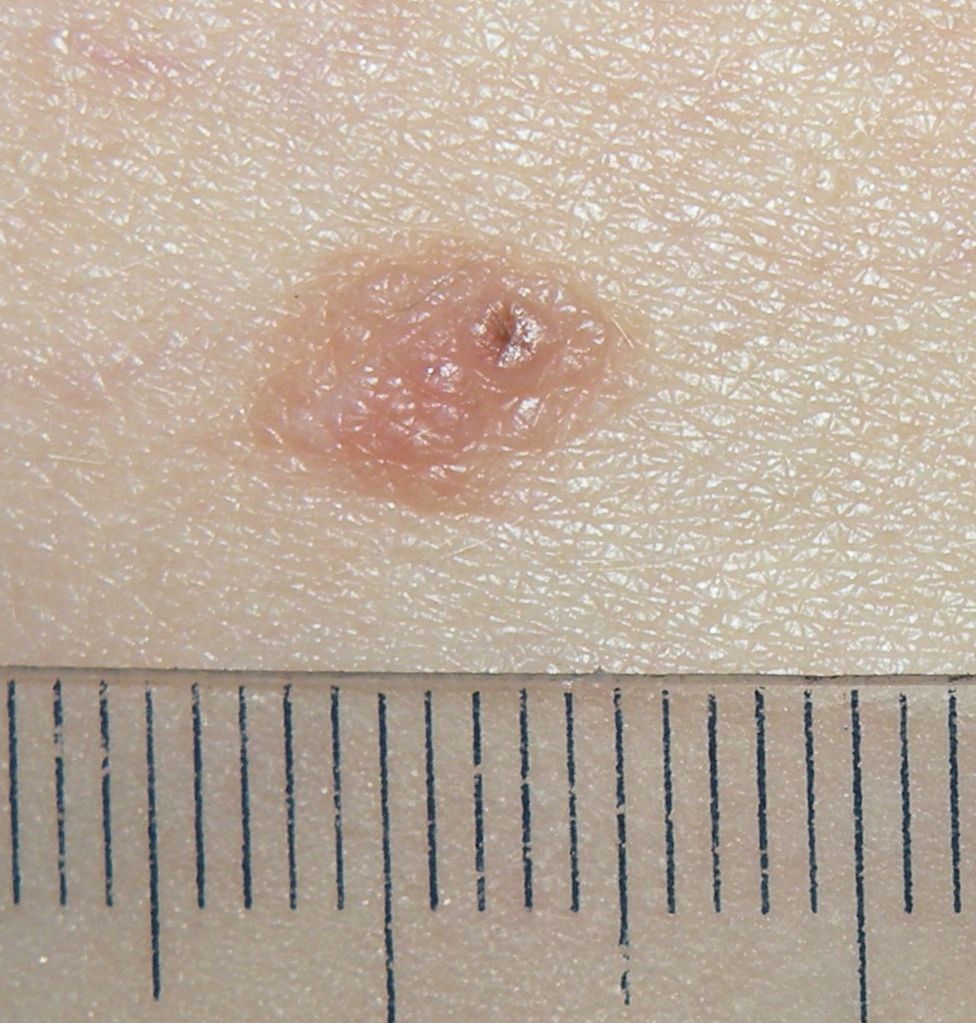
Moles are one of the most common skin changes, and most adults have between 10 and 40 of them. The great majority are harmless and stay that way. What matters is being able to recognise the few that are not — and knowing that the rule most people have heard of does not catch all of them.
In this article we explain what a mole is, what a normal mole looks like, how to use the ABCDE rule, what that rule misses, who is at risk of melanoma, and when you should see a doctor.
What is a mole?
Moles, also called naevi, are benign skin growths that form when pigment-producing cells (melanocytes) gather in clusters instead of lying evenly spread through the skin. When the cluster sits high in the skin the mole is typically flat and dark; when it sits deeper it is often raised and paler. They are usually harmless and cause neither itching nor pain.
When do moles appear?
A few are congenital, but the great majority appear during childhood and the teenage years and finish forming in the twenties and thirties. Hormones affect them: moles can darken during pregnancy and puberty. After roughly age 30–40 the skin normally stops producing new naevi — which is why a genuinely new pigmented mole in an adult is something that should be assessed.
What does a normal mole look like?
A regular mole is a small, round or oval spot with a smooth, regular border. It can be flat or raised, and the colour ranges from pink through light brown to dark brown or black — but it is even within the individual mole. Most are less than 6 millimetres across, and they change only slowly, if at all.
What can be mistaken for a mole?
The most frequent confusion is with a seborrhoeic keratosis — a benign, waxy growth that looks stuck on top of the skin and becomes common with age. A basal cell carcinoma can also resemble a mole, particularly when it is pigmented, but it typically has a pearly, translucent edge and bleeds or crusts. You cannot reliably tell them apart yourself — which is why a dermatologist uses a dermatoscope.
The ABCDE rule: when should you be concerned?
The ABCDE rule is a simple tool for judging whether a pigmented mole should be looked at more closely:
- A – Asymmetry: One half looks different from the other.
- B – Border: The edges are uneven, jagged, blurred or irregular.
- C – Colour: The colour varies within the mole, with different shades of brown, black, red, white or blue.
- D – Diameter: Larger than 6 millimetres (about the size of a pencil eraser) — though melanoma can and does occur in smaller moles, so do not use size alone to reassure yourself.
- E – Evolution: The mole is changing in size, shape, colour or surface over weeks to months. This is the single strongest sign.
ABCDE does not catch everything
Two additions matter. The ugly duckling sign: most of a person’s moles resemble each other, so a mole that stands out as different from your others deserves attention even if it passes every ABCDE test. And the EFG rule for nodular melanoma, which is often symmetric, evenly coloured and smaller than 6 mm: a lump that is Elevated, Firm to the touch and Growing steadily for more than a month should be checked promptly, whatever its colour — including pink or skin-coloured lumps with no pigment at all.
Who is at risk of melanoma?
Anyone can develop melanoma, but the risk is not evenly spread. If you belong to one or more of these groups, you should know your own skin particularly well:
- Fair skin: Fitzpatrick skin types I–II, which burn easily and almost never tan, often with freckles, light eyes and blonde or red hair.
- Many moles: More than 50 moles, or several atypical (dysplastic) naevi, raises the risk considerably.
- Melanoma in the family: A first-degree relative — parent, sibling or child — with melanoma.
- Previous skin cancer: If you have had melanoma or another skin cancer, your risk of a new one stays elevated for life.
- Sunburn and sunbeds: Blistering sunburns, especially in childhood, and the use of sunbeds increase the risk markedly.
- A weakened immune system: Organ transplant recipients and others on immunosuppressive treatment are at higher risk.
What is an atypical (dysplastic) mole?
An atypical mole is larger than most, often over 5–6 mm, with a blurred border and several shades of colour. It is not cancer, and it rarely turns into cancer itself — but having many of them signals that your overall melanoma risk is raised and that you should be followed up. Your dermatologist decides whether an individual atypical mole is removed or simply photographed and monitored.
When should you see a doctor?
Have a mole checked if you notice any of these
- A mole that meets one or more of the ABCDE criteria
- A mole that stands out as different from all your others
- A mole that bleeds, itches, becomes painful, crusts or ulcerates
- A raised, firm lump that keeps growing for more than a month — whatever its colour
- A new pigmented streak or dark band in a fingernail or toenail (subungual melanoma, which ABCDE cannot address)
- Any new mole appearing after roughly age 30–40
Early detection of melanoma saves lives: removed in time the outlook is excellent, whereas a melanoma that has had time to grow deeper is far harder to treat.
A photo assessment can tell you whether a lesion looks concerning enough to be seen in person, and how quickly. It cannot rule out skin cancer. A suspicious spot needs examination with a dermatoscope and, if there is any doubt, removal of the lesion for laboratory analysis.
What can you do yourself?
Monthly self-examination
Go over your skin once a month in good light, using a hand mirror for your back. Remember the scalp, ears, soles of the feet, between the toes and under the nails — places where melanoma is often found late.
Take photographs
Photograph the moles you are watching, in the same light and with a ruler beside them. Memory is unreliable — a photo from six months ago is the best tool you have for deciding whether something has changed.
Dermoscopy with a dermatologist
A dermatoscope magnifies and illuminates the skin so the dermatologist can see structures the naked eye cannot pick up. If you have many or atypical moles, the images can be stored and compared from visit to visit.
Protect yourself from the sun
Avoid getting burnt, use broad-spectrum sunscreen with SPF 30 or higher, seek shade in the middle of the day (12–3 pm) and never use a sunbed. Protection in childhood matters most for the risk later in life.
Should all moles be removed?
No. A normal mole does not need preventive removal, and taking moles off does not lower your risk. When a mole is removed because of suspicion, it is excised whole and sent for microscopic examination. Never burn or scrape a mole off yourself, and do not use so-called mole removal pens or acids bought online: they destroy the tissue so it cannot be examined, and they do not remove whatever may sit deeper down.
Medical classification: Moles are classified as 2F20, melanocytic naevus, in ICD-11, the WHO International Classification of Diseases. The common acquired mole is coded 2F20.0 and the atypical mole 2F20.1. Melanoma is a separate diagnosis with its own code, 2C30.
Frequently asked questions
What is a regular mole?
Moles, also called naevi, are benign skin growths that form when pigment-producing cells (melanocytes) gather in clusters instead of lying evenly spread through the skin. They are usually harmless and cause no symptoms.
What does a regular mole look like?
A regular mole is a small, round or oval spot that can be flat or raised and has an even colour ranging from pink to brown or black. Most are less than 6 millimetres across, but melanoma can also arise in smaller moles, so size alone does not tell you whether a mole is harmless.
Who gets moles?
Almost everyone. Most moles appear during childhood and early adulthood, and an adult typically has between 10 and 40. New moles appearing after roughly age 30–40 are unusual, because the formation of new naevi has normally stopped by then, and should be assessed.
When should I be concerned about a mole?
Use the ABCDE rule: Asymmetry, Border (irregular), Colour (several shades), Diameter (over 6 mm) and Evolution (change over time). Also watch for the ugly duckling — a mole that stands out from your others — and for a lump that is raised, firm and growing steadily for more than a month. A mole that bleeds, itches, hurts, crusts or ulcerates should always be seen by a doctor.
Get an assessment within 48 hours
If you are worried about a mole, you can upload photos via the SKIND app and get an assessment from a certified dermatologist. The assessment tells you how quickly you need to be seen in person: if the mole looks suspicious you will be referred for examination with a dermatoscope and possible excision. A reassuring assessment is not a substitute for in-person review if the mole keeps changing.
Download the appDisclaimer: This article is for informational purposes only and does not replace professional medical advice. Always consult a doctor or dermatologist for personal guidance and assessment of skin changes.