Scabies is one of the most contagious skin conditions you can get, affecting millions of people worldwide every year. Unlike many other skin problems, scabies is not caused by bacteria or a virus — it is a mite that burrows into the outermost layer of your skin.
In this article, we explain exactly what scabies is, why it spreads so easily, what it looks like, and what you can do to get rid of it.
What is scabies?
Scabies is a skin infestation caused by the mite Sarcoptes scabiei var. hominis. The female mite burrows small tunnels (burrows) into the outermost layer of skin — the epidermis — where she lays her eggs. The body's immune reaction to the mite, its eggs and faecal matter is what triggers the intense itching and inflammation.
Contrary to what many believe, scabies has nothing to do with poor hygiene. Anyone can get scabies — regardless of age, lifestyle or socioeconomic status. It is, however, more common in crowded environments and places with close physical contact.
What does scabies look like?
Scabies can appear in several ways:
- Intense itching — especially at night: The most prominent symptom is itching, which often worsens significantly in warm environments and at night when lying under the covers. This can make it difficult to sleep.
- Small, red bumps: These resemble small pimples or hives and are typically found on the wrists, fingers, elbows, armpits, nipples, genitals and groin. In infants, the entire body may be affected, including the scalp, face, palms and soles.
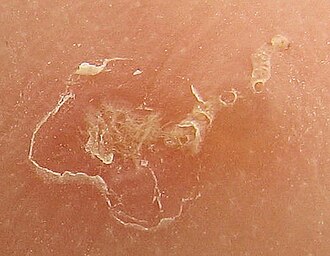
- Thin, irregular burrow lines: The characteristic thin, greyish-white or light lines on the skin that mark the mites’ tunnels. They are often short (a few millimetres) and slightly serpentine.
- Thick, scaly skin (in chronic cases): In untreated scabies over a longer period, the skin can become thick, rough and scaly, especially on the hands and feet.
Why does scabies happen?
Scabies primarily spreads through direct, prolonged skin-to-skin contact with an infected person. Since the mite cannot jump or fly, transmission requires relatively prolonged contact:
How does scabies spread through close contact?
Scabies spreads easily between family members, sexual partners and people who share a bed. A brief handshake or ordinary social contact rarely results in transmission.
Can scabies spread via shared objects?
In rare cases the mite can be transmitted via shared towels, bedding or clothing. This is most relevant in heavy infestations or institutional settings. The mite typically only survives 2–3 days outside human skin.
How long is the incubation period?
If it is the first time you have had scabies, it can take up to 4–6 weeks before symptoms appear. In reinfection in people who have previously had scabies, symptoms typically appear within 1–4 days, as the immune system already reacts faster.
Who gets scabies?
Scabies affects everyone — regardless of age, gender, ethnicity or hygiene standard. Certain factors, however, increase the risk:
- Close living conditions: Families, dormitories, nursing homes and prisons are typical places where scabies spreads.
- Sexual contact: Adults with scabies often get it through close physical contact with an infected partner.
- Weakened immune system: People with HIV/AIDS or other conditions that weaken the immune system may develop crusted scabies (also called Norwegian scabies). This form carries very large numbers of mites in the skin, is extremely contagious, causes outbreaks in care homes and hospitals, and needs urgent specialist treatment with both oral and topical medication.
- Institutional settings: Care homes for the elderly and institutions with limited healthcare staff have a higher prevalence.
How is scabies treated?
Scabies is uncomfortable but is effectively treated with prescription medication. The most important rule is: everyone in the same household must be treated at the same time — even if they have no symptoms:
Topical treatment (first-line)
Permethrin 5% cream is applied to the whole body from the neck down and washed off after 8–14 hours. In infants, young children, the elderly and people with weakened immune systems, the scalp, face, neck, palms and soles must also be treated. Include the webs of the fingers and toes, under the nails, the navel and the genitals. Treatment is repeated after one week. Cream with benzyl benzoate or sulphur is an alternative.
Oral treatment
Ivermectin in tablet form is an effective alternative, especially when topical treatment is difficult to carry out correctly. It is typically given as two doses one week apart. Ivermectin is not suitable for children weighing under 15 kg, or for women who are pregnant or breastfeeding.
Hygiene measures
All clothing, bedding and towels are washed at 50°C or above, or placed in a sealed bag for at least 72 hours. Vacuum the entire home thoroughly.
Avoid transmission
Avoid close skin-to-skin contact with others until treatment is completed. Inform all close contacts.
Medical classification: Scabies is classified as 1G04 in the WHO's International Classification of Diseases (ICD-11). It is an infestation caused by the mite Sarcoptes scabiei, causing intense itching and characteristic burrow lines in the skin.
Frequently asked questions
Is scabies dangerous?
Scabies is rarely dangerous for healthy adults, but the intense itching can ruin sleep and affect quality of life. Bacterial superinfection is common, because scratching breaks the skin — usually impetigo or cellulitis. Streptococcal superinfection can in rare cases lead to kidney inflammation (post-streptococcal glomerulonephritis), and long-standing untreated scabies can cause eczema-like skin changes.
Can scabies go away on its own?
No. Without treatment, scabies does not go away. The mite continues to lay eggs and the infestation will likely worsen over time. Treatment with prescription medication is always necessary.
Why do I still itch after treatment?
Itching can continue for 2–4 weeks after the mites are killed, because the immune reaction to the mite takes time to settle. This does not mean the treatment failed. Contact your doctor if you see new burrows or new bumps after four weeks.
When should I contact a doctor?
Contact a doctor as soon as you suspect scabies. Early treatment shortens the course of the disease and significantly reduces the risk of transmission. Children, the elderly and people with weakened immune systems should be examined promptly.
Get an assessment within 48 hours
Not sure about your symptoms? Upload photos of your skin via the SKIND app and receive a personal assessment from a certified dermatologist — no waiting list.
Disclaimer: This article is for informational purposes only and does not replace professional medical advice. Always consult a doctor or dermatologist for personal guidance and assessment of skin changes.