What is Psoriasis? Causes, Symptoms and Treatment
SkinChange.AI
Medical editorial team
Psoriasis is a chronic, autoimmune skin disease that affects millions of people worldwide. The condition causes skin cells to multiply at an unusually fast rate, resulting in red, scaly patches that are often itchy and can be painful.
In this article, we explain exactly what psoriasis is, how it differs from other skin conditions, what causes it, and what treatment options are available.
What is psoriasis?
Psoriasis is a chronic, autoimmune disease that primarily affects the skin. In psoriasis, the immune system mistakenly attacks healthy skin cells, causing them to multiply at a rate up to 10 times faster than normal. The excess skin cells build up on the surface, forming the characteristic red, scaly patches.
Psoriasis is a systemic disease, meaning it affects the entire body — not just the skin. Up to 30% of people with psoriasis also develop psoriatic arthritis, an inflammatory joint disease that can affect joints and tendons.
What types of psoriasis are there?
There are several different types of psoriasis, each with their own characteristics:
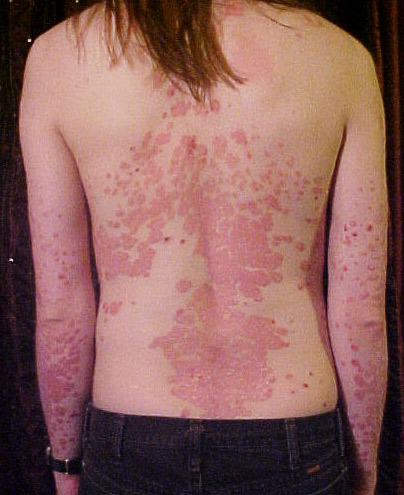
- Plaque psoriasis: The most common form, appearing as raised, red patches covered with silvery scales. Up to 80% of psoriasis patients have this type.
- Guttate psoriasis: Drop-shaped, small red spots, often triggered by streptococcal infections. Most common in children and young adults.
- Inverse psoriasis: Smooth, red skin in body folds such as armpits, groin and under the breasts.
- Pustular psoriasis: Crops of small, white pustules surrounded by red skin — pustules, not true blisters. It can be localised to the hands and feet or generalised. Generalised pustular psoriasis (von Zumbusch) causes fever and systemic illness and is a medical emergency requiring hospital treatment.
- Erythrodermic psoriasis: A rare, severe form that covers the entire body with redness and scaling. Requires immediate medical attention.
What are the symptoms of psoriasis?
Psoriasis symptoms vary from person to person, but the most common signs include:
- Red, raised skin patches covered with silvery scales
- Small, drop-shaped spots (guttate psoriasis)
- Dry, cracked skin that may bleed
- Itching, burning or soreness
- Thickened or ridged nails
- Swollen and stiff joints (psoriatic arthritis)
What causes psoriasis?
The exact cause of psoriasis is not fully understood, but research points to a combination of genetic factors and immune system response:
What happens in the immune system?
Psoriasis is primarily an autoimmune disease. The immune system's T-cells (white blood cells) mistakenly attack healthy skin cells as if defending the body against infection. This triggers a cascade of immune reactions that cause skin cells to multiply faster than normal.
Is psoriasis hereditary?
Heredity plays an important role. Up to 40% of people with psoriasis have at least one family member with the same condition. Scientists have identified several genes associated with psoriasis, including HLA-Cw6.
What can trigger a flare-up?
Many factors can trigger or worsen psoriasis:
- Stress: Psychological stress is one of the most common triggers.
- Skin injuries: Cuts, scrapes, sunburns and vaccinations can trigger psoriasis (Koebner phenomenon).
- Infections: Strep throat and other infections can trigger guttate psoriasis in particular.
- Medications: Lithium, blood pressure medications (beta-blockers) and antimalarial drugs can worsen psoriasis.
- Weather: Cold, dry weather can worsen symptoms, while sunlight often improves them.
- Alcohol and smoking: Increases the risk of psoriasis and can make treatment less effective.
How is psoriasis treated?
Although psoriasis cannot be cured, effective treatments exist that can control symptoms and improve quality of life:
When is topical treatment used?
For mild to moderate psoriasis, topical treatments are often the first choice:
- Corticosteroids: Reduce inflammation and itching. Available in creams, ointments, gels and lotions of varying strengths.
- Vitamin D analogues: Slow cell growth and scaling, e.g. calcipotriol.
- Retinoids: Vitamin A derivatives that normalise cell growth.
- Salicylic acid: Removes scales and softens thick skin.
How does phototherapy work?
Phototherapy uses ultraviolet light to slow cell growth:
- NB-UVB (narrowband UVB): Narrowband ultraviolet B light, the most widely used phototherapy for moderate psoriasis — more effective than broadband UVB and with fewer side effects.
- PUVA: Combination of psoralen (photosensitising medication) and UVA light.
When is systemic or biologic treatment needed?
For moderate to severe psoriasis, systemic medications and biologic therapies may be necessary:
- Biologics: Newer drugs that specifically target parts of the immune system (TNF-alpha, IL-17, IL-23). They are highly effective, but require screening for infections such as tuberculosis before starting, and ongoing specialist monitoring.
- Conventional systemic treatments: Methotrexate, ciclosporin and acitretin. They act on the whole body and require regular blood tests. Methotrexate is teratogenic, as is acitretin, so neither may be used in pregnancy.
- Apremilast: Oral medication that inhibits an enzyme involved in inflammation.
When should you see a doctor?
See a doctor if red, scaly patches do not clear after a couple of weeks of over-the-counter care, if the rash is spreading, if your nails change, or if you develop swollen and stiff joints. Several other conditions cause red, scaly patches — for example seborrhoeic dermatitis on the scalp and face (sebopsoriasis) and lichen planus — and they are treated differently, so the correct diagnosis matters.
⚠️ When to seek urgent help
Seek urgent medical help if redness and scaling spread over almost the whole body (erythrodermic psoriasis), or if you develop a crop of pus-filled pustules together with fever and chills (generalised pustular psoriasis). Both can affect circulation and fluid balance and need hospital treatment.
Medical classification: Psoriasis vulgaris (plaque psoriasis) is classified as EA90.0 in the WHO's International Classification of Diseases (ICD-11). It is a chronic, immune-mediated skin disease with sharply demarcated, scaly plaques, managed with topical agents, phototherapy and systemic or biologic drugs.
Frequently asked questions
Is psoriasis contagious?
No, psoriasis is not contagious. You cannot get psoriasis by touching someone with the condition, and it is not transmitted through blood or other body fluids.
How does psoriasis affect quality of life?
Psoriasis can have a significant psychological impact due to visible skin changes. Many experience stigmatisation, low self-esteem, anxiety and depression, and studies find an increased rate of suicidal thoughts, particularly in severe psoriasis. Early and effective treatment is important.
Do diet and lifestyle help with psoriasis?
No diet can cure psoriasis, but some lifestyle changes can help: maintain a healthy weight, avoid smoking and alcohol, manage stress, and eat an anti-inflammatory diet with omega-3 fatty acids.
Get an assessment within 48 hours
If you are experiencing persistent skin changes that could be psoriasis, you can get a personal assessment from a certified dermatologist via the SKIND app — no waiting list.
Disclaimer: This article is for informational purposes only and does not replace professional medical advice. Always consult a doctor or dermatologist for personal guidance and assessment of skin changes.